[caption id="attachment_5256" align="aligncenter" width="4608"]
So simple, and yet so complex[/caption]
I’m hesitating as I write this. A vote in a General Election is a private affair made public by all sorts of pronouncements by all and sundry. I’m wondering how many Twitter friends this post will lose me, how much criticism this post will attract, so polarised have we become as a society.
Yet this has preyed on my mind for such a long time that I can no longer hold my cards close to my chest or keep quiet in order to fend off any controversy. This is my blog and I should be able to express my views as long as I am harming no-one else.
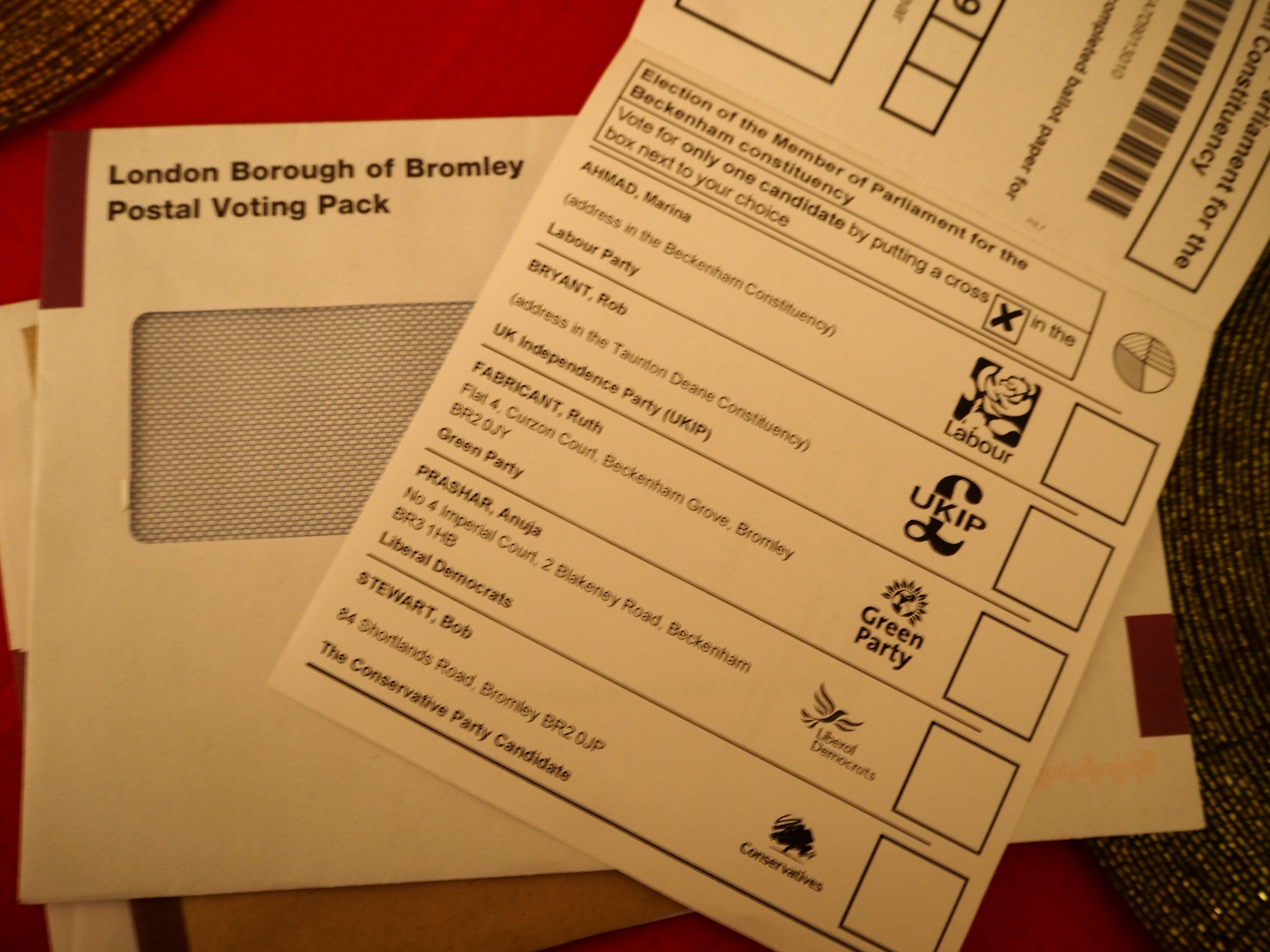
There is a body of opinion that feels that voting is of no consequence, that it changes nothing, especially in our system of non-proportional representation. This is so completely the case in my constituency of Beckenham, one of the safest Conservative seats in the land, that it’s almost not worth voting for any party because one’s vote is of no consequence whatsoever. And yet so many have struggled, suffered and died for our right to have our say in who governs our country that, to me at least, it seems like an insult to them to squander the one voice we have.

But how to use one’s vote?
Most of the people I follow on Twitter, including many dear friends are left wingers, generally believers in compassion and doing one’s best to help care for people outside one’s immediate family. Nice people. This is probably why I follow them.
I must point out here that compassion, kindness, gentleness, courtesy are not uniquely the preserve of people who are largely left-leaning. Generally I am still interacting with people who can keep a civil tongue in their heads, no matter what their politics. I’d also like to think that I treat people with courtesy even though I am a floating voter and, as such, don’t stand for anything much. Sadly, at election time, a lot of otherwise perfectly reasonable, decent people resort to name calling for which my stomach is far too delicate.
I don’t like how acrimonious the exchanges have become, though. Personal attacks and general nastiness seem to be the order of the day, justified by people’s violent disagreement with the other side. Sometimes it is simply a matter of lack of imagination, of lack of seeing the other side of the story. There’s no need to be rude, though. It’s deeply off-putting and I find myself disengaging completely with the world of politics. I just can’t be doing with it.
How very odd for someone once so engrossed in politics, raised in such a politically-aware household. Should I not be somewhere helping a party with their campaign, leafletting, canvassing, making my political allegiances known on social media?
The problem is that I can see both sides of the story: I decide where I stand on the basis of policies and not tribalism, which I hate. I’m really annoyed that people are so ready to judge and dismiss people for their name; the school to which their parents sent them; their job; where they live. I don’t understand the deep disconnect between people and other people.
In essence I am socially liberal and believe in community but the sort of community where everyone cares and everyone has to face the consequences of their actions, where people have to take some responsibility, at least, for themselves. This makes me fiscally conservative: as a housewife with no income I know how very easy it is to spend money that someone else has earned. It is a huge conflict and one with which I tussle all the time.
So much of this election seems to be about bashing the people that one side or the other hates, whether it’s demonising people who come here to do the work that people are not sufficiently skilled to do, or do the work for cheaper; or whether it’s vilifying people who have achieved success in life through their skills and capabilities and hard work.
I believe in social responsibility, yes, but also in personal responsibility. For instance, I think it is right that our taxes should pay for good healthcare and education for our children. What I think it less fair is that some people think carefully about how many children they can afford to feed, clothe and educate whereas other seems to think that everyone else should pick up the bill for their unrestrained procreation.
I don’t automatically think that the public sector is good and the private sector is bad.
I believe in equality of opportunity not equality of outcome. It seems that many people support people’s right to do well but become filled with resentment and loathing when they do make a success of their lives.
That sort of thing.
There is so much I could write about this here but I’d be on and on for days because a) there is more than one side to every situation and b) things are always more complex than most people would like to acknowledge. Essentially, I’m a dithering fence-sitter.
I refuse to vote for a party that actively seems to dislike people like me. This, then, rules out the Conservatives, plenty of whom make it blatantly obvious that they'd rather not have people like me around, that they merely tolerate me, and that they don’t want me to live in the same street as them. You’re shocked? You wouldn’t believe some of the encounters I’ve had with past neighbours because neither did I. UKIP, obviously, are the party of the stupids and there are far too many of them about.
And yet Labour, whom I supported until Gordon Brown reignited class warfare (and supported the third runway at London Heathrow airport,) seem now to go out of their way to pour scorn and hatred on people who have managed to achieve success not through inheritance or criminality but through making good choices at school and sheer hard work. Also, let’s be honest, luck. When you’re not a billionaire like poster girl JK Rowling, a 25% tax rise makes a huge amount of difference to your ability to manage your household expenses, especially in London. I am sure those baying for us to pay even more tax wouldn’t like a similar rise in their own tax rate.
I have voted for the Greens in the past but their attitudes have also disappointed me during this election campaign. It’s almost as if they don’t care whether people take them seriously or not. They despise people like us too. A vote for them would be a vote for paying 60% tax which, if you look at it totally dispassionately, would be a deeply illogical thing to do. It’s such a pity because if anything we do need to be taking environmental concern a whole lot more seriously than we do at the moment.
Now let’s get this straight: I don’t look down on or despise poor people. I am not a snob. (I’m almost incredulous that I find myself having to explain that, but such is the current polarisation and hatred that I feel I must.) I too have been long-term unemployed (with two degrees and plenty of skills) and I know what it’s like to write hundreds of letters and be dismissed out of hand at the rare interview for reasons that never become clear. I know what it’s like to walk miles to sign on in order to save the bus fare.
I sympathise hugely with people who are having to live on next to nothing. I see first hand the effect of some of the cuts on youth services and on people with mental health problems. But I don’t see why I have become the enemy because my life is no longer like this. I cannot vote for people who exist to pour scorn on people like me.
Which means that, in the end, my vote will be cast for the least of all the evils, from my point of view. And I’m not sure that’s quite in the spirit of democracy.
Member comments